

Water Hardness: A Hidden Challenge Beneath Our Feet
With surface water increasingly strained by climate variability and growing demand, groundwater has emerged as our critical fallback resource. Yet despite its abundance, groundwater often fails to deliver its full potential4its natural vitality constrained by invisible chemical forces that quietly compromise performance across all applications.
THE TURNING POINT
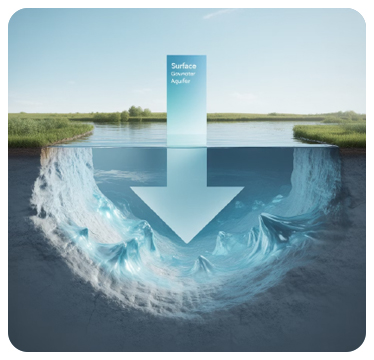
Groundwater naturally accumulates elevated levels of dissolved salts through prolonged contact with underground rocks and minerals. As water slowly percolates through soil and geological layers, it dissolves calcium, magnesium, sodium, and sulfates through a process known as mineral
dissolution. Over time, and with increasing depth, this process intensifies4making older or deeper groundwater progressively harder and more saline.
While these minerals are beneficial in trace amounts, excessive concentrations pose serious challenges across
widespread uses4from agriculture and industry to infrastructure and human consumption.
The issue becomes particularly pronounced in arid and semi-arid regions, where high evaporation rates and over-extraction further concentrate dissolved salts. Poor drainage and repeated irrigation cycles compound the problem, returning mobilized salts back into aquifers and creating a self-reinforcing cycle of rising water hardness.

The result is chemically heavyî water laden with excess mineral salts. Invisible to the eye, yet potent in effect. Groundwater hardness quietly erodes efficiency, productivity, and long-term sustainability a cross every sector it touches. Its impact is felt both upstream, during treatment and distribution, and downstream, in end-use performance, maintenance burden, and waste generation.
For decades, constrains imposed by hard water-and the resulting losses in productivity have been treated as an unavoidable operational cost and accepted as a compromised normal largely due to the absence of viable, scalable alternatives managed through chemical dosing, frequent maintenance, or premature equipment replacement. These approaches mitigate symptoms but do not address the underlying physicochemical behavior of dissolved mineral salts.
Addressing Water Hardness Through MWT
For decades, the limitations imposed by hard water have been treated as an unavoidable operational cost managed through chemical dosing, frequent maintenance, or premature equipment replacement. These approaches mitigate symptoms but do not
address the underlying physicochemical behavior of dissolved mineral salts.
Magnetic Water Treatment (MWT) offers a physical, non-chemical method to modify this behavior at the source. By exposing flowing groundwater to controlled magnetic fields, MWT influences the way hardness-causing minerals interact, aggregate, and crystallize without altering water chemistry or adding external substances.
Installed inline, magnetic treatment systems operate continuously, requiring no energy input beyond initial installation and producing no chemical residuals or waste streams. The result is a change in how mineral salts behave within the water system, rather than their removal.