

Strengthening Public Water Systems:
A Sustainable Health- and Infrastructure-Centered Approach
Introduction & Context
Providing safe drinking water remains a persistent global challenge, particularly in developing regions were resource constraints limit access to advanced purification technologies and continuous monitoring systems.
Despite advances in treatment science, chlorination remains the foundational safeguard of public water systems, relied
upon worldwide for its robustness, affordability, and ability to maintain microbial protection throughout extensive and often aging distribution networks. Its residual disinfecting power ensures water safety from treatment facility to end user, especially in regions characterized by intermittent water pressure, variable source quality, and infrastructure limitations.
The Chlorination Paradox
However,the samechemical reactivitythat makes chlorine indispensable for pathogen control also introduces unintended and cumulative consequences when applied continuously across complex water systems.
The Need for Integrated, Future-Ready Solutions
Asgovernments, municipalities,and development agenciessearchfor answers to mounting public health and infrastructure pressures, there is a growing need for technologies that offer multiple, measurable benefits with minimal additional resource input. Future-ready solutions must be cost-effective, scalable, energy efficient, easy to integrate into existing systems and adaptable across socio-economic and geographic contexts.
Magnetic Water Treatment: A Bridge to Safer Water
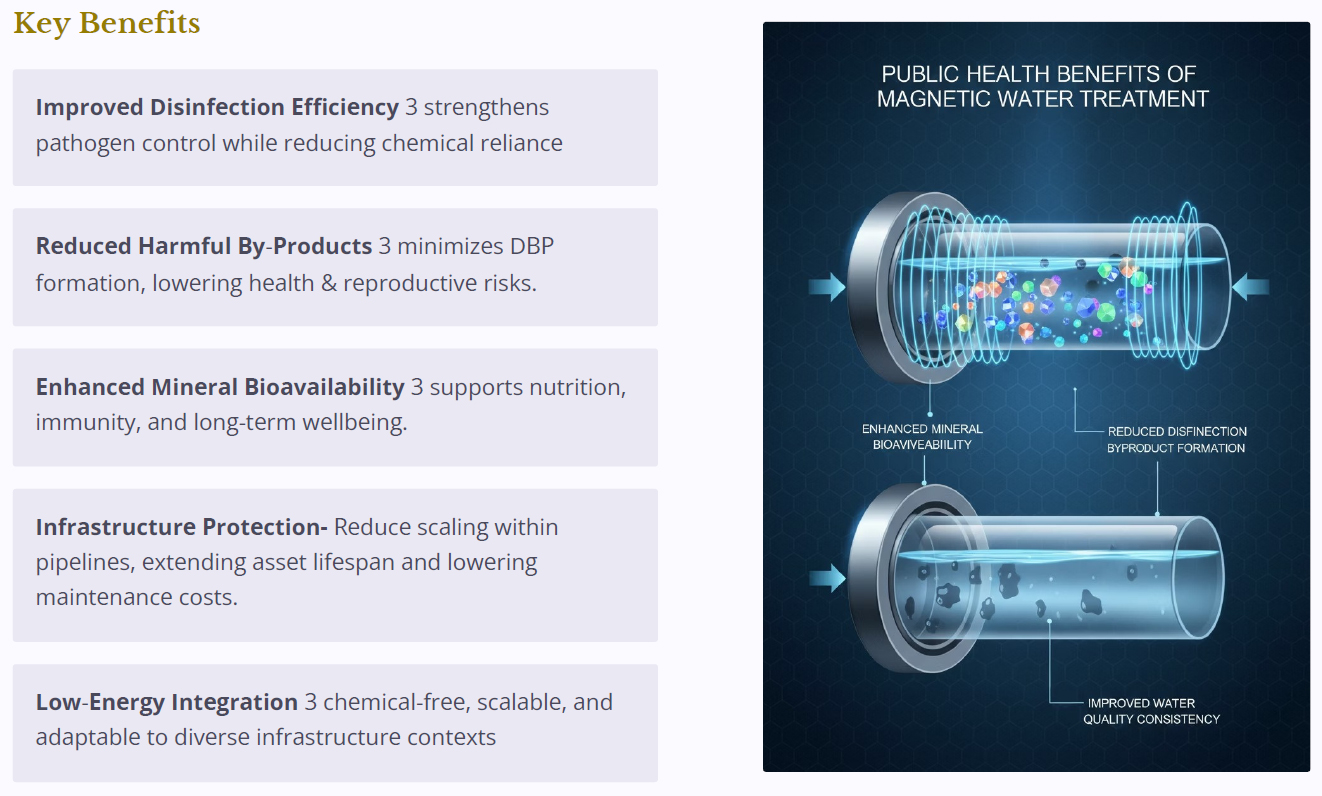
Magnetic Water Treatment offers a dual benefit: improving water quality and supporting human health. By altering water's physical and chemical properties, MWT enhances chlorine efficiency and improves mineral solubility and absorption, offering a compelling, scalable solution for public infrastructure. MWT holds particular promise for underserved and marginalized communities, where incremental improvements in water quality can translate into significant gains in population health, productivity, and resilience.
Call to Action
Forpublic healthauthorities, water boards, municipal planners, and development agencies seeking high-impact, low-input interventions, Magnetic Water Treatment offers a powerful opportunity to enhance water safety, improve public health outcomes, and extend infrastructure life 4 all through a single, cost-effective integration.
MWT works seamlessly across both centralized and decentralized systems, making it equally suitable for urban, peri-urban, and rural deployment.
As a true < bridge technology,= MWT represents more than an incremental upgrade for addressing today9s limitations and tomorrow's sustainable water future it signals a paradigm shift, moving from resource-intensive treatment models toward intelligent, passive enhancement aligned with global sustainability and public health priorities.